Gold is one of the most valuable and widely used precious metals in the world. From fine jewelry and investment pieces to decorative items, gold is available in different levels of purity. However, pure gold is naturally soft, which is why it is often mixed with other metals to create stronger and more practical gold alloys.
Understanding exactly how much pure gold and other metal are present in an alloy can sometimes be confusing. A Gold Alloy Calculator makes this process much easier. Instead of performing complicated calculations manually, you can use a Gold Alloy Calculator to estimate gold content, purity, karat, and the amount of alloying metal in a piece.
Whether you are a jeweler, gold buyer, collector, student, or simply curious about the composition of your jewelry, understanding gold alloys can help you make better-informed calculations.
In this guide, we will explain how a Gold Alloy Calculator works, what gold alloys are, how karat relates to purity, and how to calculate the amount of pure gold contained in different alloys.
Table of Contents
ToggleWhat Is a Gold Alloy Calculator?
A Gold Alloy Calculator is a tool designed to help calculate the composition of a gold alloy based on information such as total weight and gold purity.
Gold jewelry is rarely made entirely from pure gold. Instead, gold is commonly mixed with metals such as silver, copper, zinc, nickel, or palladium to modify characteristics including strength, durability, hardness, and color.
For example, 24K gold is generally used to represent nearly pure gold, while 18K gold contains 18 parts gold out of 24.
That means:
18 ÷ 24 = 0.75
So 18K gold is approximately 75% gold by mass.
A Gold Alloy Calculator can perform this type of conversion automatically and help estimate how much of an item’s weight represents gold versus other metals.
What Is a Gold Alloy?
A gold alloy is a mixture of gold and one or more other metals.
Pure gold is highly valued, but its softness can make it less suitable for jewelry that needs to withstand regular wear. By combining gold with other metals, manufacturers can create materials with different physical properties and appearances.
Common alloying metals include copper, silver, zinc, nickel, and palladium.
The exact composition depends on the desired karat, color, manufacturing method, and product.
A Gold Alloy Calculator focuses primarily on the mathematical composition of the alloy. It can tell you the estimated quantity of gold and non-gold material based on the purity you provide.
How Does a Gold Alloy Calculator Work?
A basic Gold Alloy Calculator uses the total weight of an item and its gold purity.
For example, suppose you have 20 grams of 18K gold.
Because 18K represents 18 parts gold out of 24:
18 ÷ 24 = 0.75
Then multiply the total weight by the purity:
20 × 0.75 = 15 grams
The piece therefore contains approximately 15 grams of pure gold.
The remaining weight is:
20 − 15 = 5 grams
Those five grams represent the other metals in the alloy.
A Gold Alloy Calculator automates these steps so you can get the result quickly.
Gold Karat and Purity Explained
Understanding the karat system is essential when using a Gold Alloy Calculator.
Karat indicates the proportion of gold in an alloy on a 24-part scale.
In simplified terms:
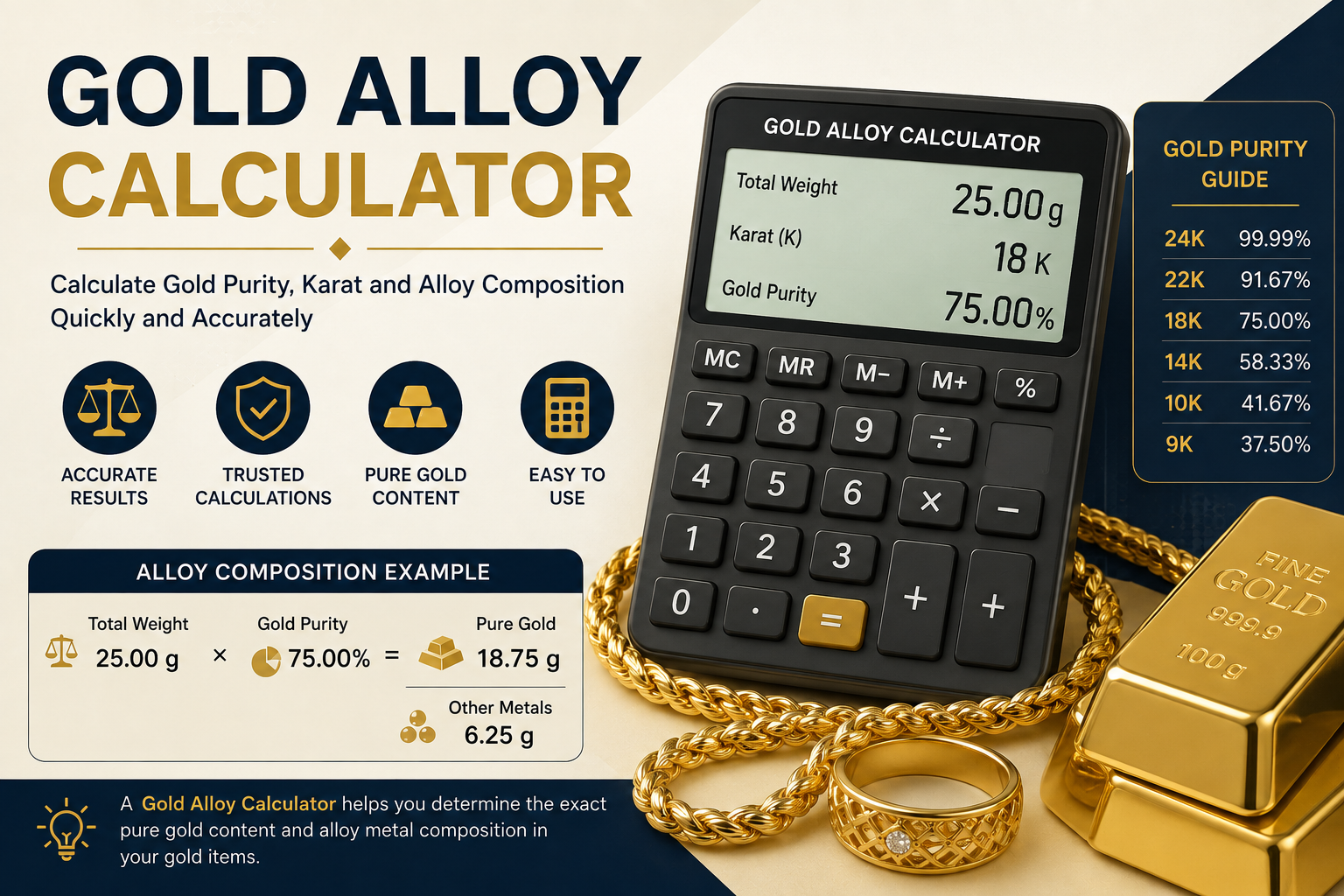
24K = approximately 100% gold
22K = approximately 91.67% gold
18K = 75% gold
14K = approximately 58.33% gold
10K = approximately 41.67% gold
9K = 37.5% gold
For example, if an item weighs 12 grams and is 14K:
14 ÷ 24 = 0.5833
Then:
12 × 0.5833 ≈ 7 grams
The item therefore contains approximately seven grams of pure gold.
The Gold Alloy Calculator can make these conversions easier, especially when working with multiple weights and purity levels.
How to Calculate Pure Gold in an Alloy
You can calculate pure gold content manually using a simple formula:
Pure Gold Weight = Total Weight × Gold Purity
If purity is given in karats, convert it first:
Gold Purity = Karat ÷ 24
Suppose you have 30 grams of 22K gold.
First:
22 ÷ 24 = 0.9167
Then:
30 × 0.9167 ≈ 27.5 grams
So the alloy contains approximately 27.5 grams of gold.
The remaining approximately 2.5 grams consist of alloying materials.
Using a Gold Alloy Calculator is faster when you need to repeat this calculation for several items.
Gold Alloy Calculator for 24K Gold
24K gold represents the highest commonly referenced karat level and is generally treated as essentially pure gold for basic calculations.
If you enter 10 grams of 24K gold into a simple Gold Alloy Calculator, the calculated gold content will be approximately 10 grams.
However, actual commercial products described as 24K may have specific fineness standards rather than being chemically 100.000% pure.
For general calculator purposes, the karat-to-purity relationship provides a convenient estimate.
Gold Alloy Calculator for 22K Gold
22K gold is common in jewelry in many parts of the world.
Its theoretical gold proportion is:
22 ÷ 24 × 100 = 91.67%
Suppose you have a 50-gram 22K gold item.
Using the Gold Alloy Calculator formula:
50 × 0.9167 ≈ 45.84 grams of gold
The remaining approximately 4.16 grams represent alloying metals.
The actual alloy composition can vary depending on how the jewelry was manufactured.
Gold Alloy Calculator for 18K Gold
18K gold contains 18 parts gold out of 24.
That equals:
18 ÷ 24 = 75%
If an 18K bracelet weighs 40 grams:
40 × 0.75 = 30 grams
It contains approximately 30 grams of gold and 10 grams of other metals.
A Gold Alloy Calculator is useful here because you can quickly change the total weight and instantly estimate the pure gold content.
Gold Alloy Calculator for 14K Gold
14K gold is widely used for jewelry because it combines gold content with durability.
Its theoretical purity is:
14 ÷ 24 × 100 ≈ 58.33%
For example, a 24-gram 14K piece contains approximately:
24 × 0.5833 ≈ 14 grams of gold
The remaining approximately 10 grams consist of non-gold alloy components.
With a Gold Alloy Calculator, users can perform the same calculation without manually converting the karat each time.
Gold Alloy Calculator for 10K Gold
10K gold has a theoretical gold proportion of:
10 ÷ 24 × 100 ≈ 41.67%
If a piece of 10K jewelry weighs 18 grams:
18 × 0.4167 ≈ 7.5 grams
The estimated pure gold content is therefore around 7.5 grams.
The remainder is composed of other metals.
This demonstrates why knowing both the weight and karat is important when calculating gold content.
Understanding Gold Fineness
Gold purity may also be expressed as fineness rather than karat.
Fineness typically represents the proportion of gold in parts per thousand.
For example:
999 represents approximately 99.9% gold.
916 represents approximately 91.6% gold.
750 represents 75% gold.
585 represents 58.5% gold.
375 represents 37.5% gold.
A more advanced Gold Alloy Calculator may allow you to enter either karat or fineness, making it easier to work with different gold-marking systems.
Gold Alloy Calculator and Yellow Gold
Yellow gold typically combines gold with metals such as silver and copper, although formulations vary.
The karat determines the overall proportion of gold, while the remaining percentage consists of the alloying metals.
For instance, 18K yellow gold is approximately 75% gold. The remaining 25% may consist of a particular mixture selected by the manufacturer.
A Gold Alloy Calculator can determine the overall gold and non-gold portions, but it cannot know the exact silver-to-copper ratio unless that information is supplied.
Gold Alloy Calculator and White Gold
White gold is created by combining gold with metals selected to produce a lighter appearance and different physical properties.
Depending on the formulation, white gold alloys may contain metals such as palladium, nickel, silver, zinc, or combinations of other materials.
For 18K white gold, the gold proportion remains approximately 75%.
So a 20-gram 18K white gold item would contain approximately:
20 × 0.75 = 15 grams of gold
The remaining five grams would represent the other alloy components.
The Gold Alloy Calculator can estimate the gold portion even when the exact formulation of the remaining alloy is unknown.
Gold Alloy Calculator and Rose Gold
Rose gold gets its distinctive pink or reddish appearance primarily from its alloy composition, commonly involving copper.
For example, 18K rose gold still contains approximately 75% gold.
If an 18K rose gold ring weighs eight grams:
8 × 0.75 = 6 grams of gold
The remaining approximately two grams consist of alloying metals.
A Gold Alloy Calculator helps separate the gold portion from the total alloy weight regardless of whether the item is yellow, white, or rose gold.
Why Are Other Metals Added to Gold?
There are several reasons for creating gold alloys.
One of the most important is durability. Pure gold is relatively soft, so adding other metals can increase hardness and make jewelry more suitable for everyday wear.
Alloying also changes appearance. Different metal combinations can produce yellow, white, rose, and other gold tones.
Manufacturers may also choose particular compositions to achieve desired properties during casting, forming, polishing, or other production processes.
A Gold Alloy Calculator helps users understand the numerical side of these mixtures by showing how much gold is present at a particular purity level.
How to Use a Gold Alloy Calculator
Using a Gold Alloy Calculator should be simple.
First, enter the total weight of your gold item. Make sure you select or use the correct unit, such as grams, ounces, or another supported measurement.
Next, enter or select the gold purity. This might be expressed as karat, such as 18K, or fineness, such as 750.
The calculator then estimates the amount of pure gold and the amount represented by other alloying materials.
If the calculator supports more advanced alloy calculations, it may also allow you to enter target purity or individual metal proportions.
Always check what each input and result represents before relying on the calculation.
Benefits of Using a Gold Alloy Calculator
The main advantage of a Gold Alloy Calculator is convenience.
It eliminates the need to repeatedly convert karats into percentages and manually multiply those percentages by weight.
The calculator can be helpful for jewelry owners who want to understand their items, students learning about gold purity, collectors comparing different pieces, and professionals who need quick preliminary calculations.
It can also reduce simple arithmetic errors when handling several items with different weights and karats.
However, the result is only an estimate based on the data entered.
Gold Alloy Calculator for Jewelers
Jewelers often work with multiple gold purities and alloy compositions.
A Gold Alloy Calculator can provide a convenient way to perform basic purity and weight calculations when planning or reviewing jewelry work.
For example, a jeweler may need to understand how much pure gold is theoretically present in a particular quantity of 18K material.
Instead of calculating the percentage manually each time, the calculator can provide the result instantly.
Professional alloy production can involve additional technical factors, so a basic online calculator should not replace appropriate manufacturing procedures, testing, or professional expertise.
Gold Alloy Calculator for Gold Buyers
Gold buyers may encounter jewelry with different karat markings.
A Gold Alloy Calculator can help estimate the theoretical gold content of an item based on its stated purity and weight.
For instance, two pieces weighing the same amount can contain very different amounts of gold if one is 22K and the other is 10K.
The calculator makes that difference easy to see.
However, markings alone do not guarantee actual purity. Professional testing may be necessary when accurate valuation or authenticity is important.
Does a Gold Alloy Calculator Tell You the Gold Value?
A standard Gold Alloy Calculator primarily calculates composition and purity.
To estimate monetary value, you also need a gold price for the relevant unit and purity basis.
A simplified formula might be:
Estimated Gold Value = Pure Gold Weight × Gold Price per Unit
For example, if an item contains an estimated 15 grams of pure gold, its theoretical gold value would depend on the current price of gold per gram.
Actual resale offers may differ because of dealer margins, refining costs, testing, market conditions, craftsmanship, collectible value, and other factors.
Therefore, gold content and selling price should not be treated as the same thing.
Common Mistakes When Calculating Gold Alloys
One common mistake is confusing karat with total weight.
An 18K item is not “18 grams of gold.” The 18K label describes purity, not weight.
Another mistake is treating 18K gold as 18% pure. In reality, 18K represents 18 out of 24 parts, which equals 75%.
Users may also assume that a Gold Alloy Calculator can determine the exact composition of every non-gold metal from karat alone.
It cannot. Knowing that an alloy is 75% gold tells you that approximately 25% is other material, but additional information is needed to identify exactly how that remaining percentage is divided among individual metals.
Frequently Asked Questions About Gold Alloy Calculator
What is a Gold Alloy Calculator?
A Gold Alloy Calculator is a tool used to estimate gold purity, pure gold weight, and the non-gold portion of an alloy based on information such as total weight and karat.
How do I calculate gold alloy purity?
Divide the karat value by 24 and multiply by 100.
For example:
18 ÷ 24 × 100 = 75%
Therefore, 18K gold is theoretically 75% gold.
How much pure gold is in 18K gold?
18K gold contains approximately 75% gold by mass.
How much pure gold is in 14K gold?
Using the 24-karat scale, 14K gold is approximately 58.33% gold.
How much pure gold is in 22K gold?
22K gold is approximately 91.67% gold.
Can I calculate gold value using a Gold Alloy Calculator?
If the calculator also includes current or manually entered gold prices, it may estimate value. A basic alloy calculator, however, primarily focuses on purity and composition.
Is a Gold Alloy Calculator accurate?
The arithmetic can be accurate based on the inputs provided. However, the actual purity of a physical item may differ from its stated or assumed purity, so professional testing is required when precise composition matters.
Final Thoughts
Understanding gold alloys does not need to involve complicated manual calculations.
A Gold Alloy Calculator provides a simple way to estimate how much pure gold is contained in an item based on its weight and purity. It can also help you understand how much of the total weight consists of other alloying materials.
Whether you are working with 24K, 22K, 18K, 14K, 10K, or another purity level, the Gold Alloy Calculator can quickly convert karat into useful composition information.
It is particularly useful for jewelry owners, collectors, students, gold buyers, and professionals who regularly compare different gold purities.
For the best results, always enter accurate weight and purity information. Remember that calculated purity is not a substitute for professional testing of a physical gold item.
By using a Gold Alloy Calculator, you can better understand gold composition, compare different karats, and make gold purity calculations faster and easier.
To learn more about gold jewelry, purity, and proper care, visit the Gemological Institute of America (GIA). Their educational resources provide reliable information that can help you better understand gold jewelry and its characteristics.
Pingback: Gold Calculator for Gold Investment Best 2026