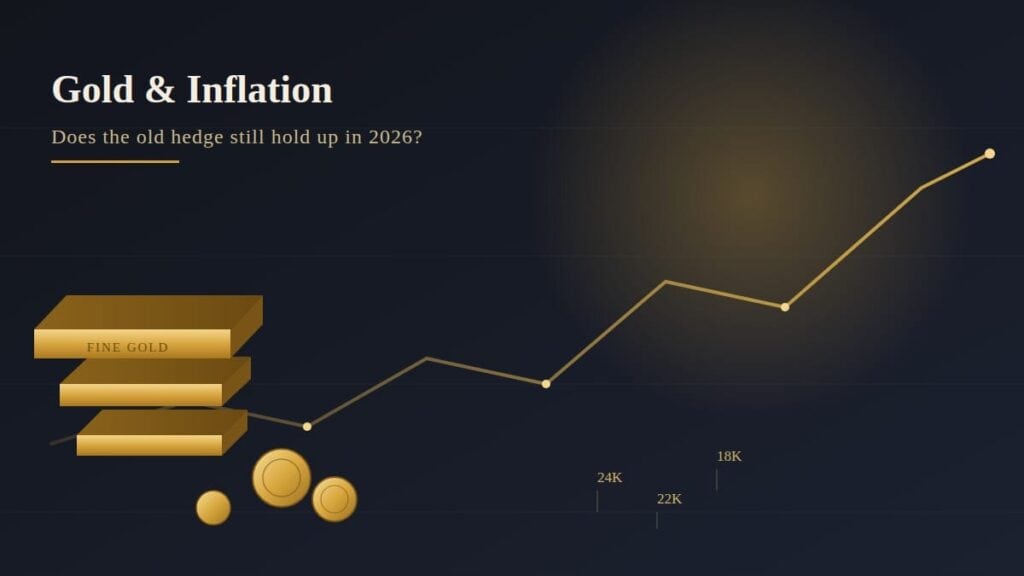
The gold inflation hedge is one of the oldest rules in personal finance: when prices rise, gold is supposed to rise with them.
For most of our lives, one financial rule felt almost sacred…For most of our lives, one financial rule felt almost sacred: when inflation goes up, gold goes up with it.
Grandparents said it, financial advisors repeated it, and every gold shop banner reminded us of it.
But 2026 has been a strange year for that rule. Inflation climbed to some of its highest levels in years, and yet gold prices actually pulled back from their record highs earlier in the year.
Understanding the gold inflation hedge properly helps you make smarter buying decisions, no matter which way prices move next.
So the question a lot of people are asking right now — including anyone who’s been watching prices on a gold calculator wondering whether to buy — is simple: does gold still protect you from inflation, or was that always a bit of a myth?
The honest answer is: it’s more complicated than “yes” or “no.” Let’s walk through what’s actually happening.
A Quick Reality Check on 2026’s Gold Market
If you tracked gold prices since the start of this year, you probably noticed something odd. Gold hit an all-time high around late January, trading near record levels above $5,500 an ounce.
Understanding the gold inflation hedge properly helps you make smarter buying decisions, no matter which way prices move next.
Then, instead of continuing to climb as inflation numbers kept rising through the spring and into summer, gold actually dropped — by roughly a quarter from that peak, settling in the $4,100 to $4,300 range by late June.
That’s the part that confuses people. Inflation went up.
Gold went down. Wasn’t gold supposed to do the opposite?
This is exactly where the “inflation hedge” idea gets misunderstood. Gold isn’t really reacting to inflation directly — it’s reacting to what central banks do about inflation.
It’s Not Inflation. It’s Interest Rates.
Here’s the mechanism that actually drives gold prices, and it’s worth understanding properly because it explains almost everything happening this year.
Gold doesn’t pay you interest or dividends. If you’re holding a bar of gold, it just sits there.
So whenever interest rates on safer assets like government bonds or savings accounts go up, gold becomes less attractive by comparison — investors can earn a guaranteed return elsewhere instead of holding a metal that earns nothing.
In 2026, inflation rose partly because of an energy price shock tied to conflict in the Middle East, along with lingering effects from tariffs.
Normally, central banks might respond to a slowing economy by cutting rates, which would be great for gold.
But this time, instead of cutting rates, major central banks — including the Federal Reserve under its new leadership — chose to keep rates high, treating inflation control as the top priority.
The European Central Bank followed a similar path, raising rates in June.
Higher rates meant that holding cash or bonds suddenly looked more appealing again.
That pulled money away from gold, even while inflation itself was climbing. Several major banks trimmed their year-end gold price targets as a result — though notably, most of those revised targets are still well above where gold is trading right now, suggesting many analysts still expect a recovery.
So Has Gold Stopped Being an Inflation Hedge?
Not exactly — but it’s fair to say the relationship is less automatic than the old saying suggests. A more accurate way to think about it: gold protects against the combination of high inflation and low or falling interest rates.
When both of those line up, gold tends to shine, because the real return on cash and bonds turns negative, making a non-yielding asset like gold comparatively more attractive.
When inflation is high but interest rates are also high, the two forces pull against each other, and gold can stall or even fall — which is basically what’s been happening for parts of 2026.
There’s also a structural layer to this that shorter-term price swings don’t capture. Central banks around the world — not individual investors, but actual national reserve banks — have continued buying gold at a healthy pace this year, adding to reserves even during the price pullback.
That kind of long-term institutional demand doesn’t disappear because of a few months of rate-driven price weakness.
It reflects bigger, slower-moving concerns: currency diversification, government debt levels, and reducing reliance on any single reserve currency.
What This Means If You’re Thinking About Buying Gold
If you’re evaluating gold jewelry, coins, or bars right now — whether as a saver in Pakistan watching PKR gold rates, or anyone tracking USD gold prices — a few practical takeaways are worth keeping in mind:
Gold is a long-term protection tool, not a short-term inflation thermometer.
Its price won’t move in lockstep with this month’s inflation report. Judging it on a month-to-month basis will usually leave you disappointed either way.
Watch interest rate expectations, not just inflation headlines.
If central banks signal they’re getting ready to cut rates, that’s historically been a much bigger green flag for gold than inflation data alone.
Diversification still matters more than timing.
Most financial advisors suggest gold shouldn’t make up more than a modest slice of a portfolio — often cited in the 5% to 15% range — rather than treating it as an all-or-nothing bet against inflation.
Purity and pricing still matter every single time you buy.
Whatever direction the market takes, knowing exactly what you’re paying for — 22K versus 24K, spot price versus local premium — protects you regardless of where gold’s price ends up next.
The Bottom Line
Gold hasn’t lost its role as a store of value, but 2026 has been a useful reminder that it was never a simple, automatic inflation hedge. What actually moves gold is the relationship between inflation and interest rates — not inflation on its own.
When real yields fall, gold tends to do well. When central banks stay aggressive on rates even as prices rise, gold can lag, exactly as we’ve seen this year.
For everyday buyers, that nuance doesn’t change much about the fundamentals: gold remains one of the few assets that holds value independently of any single government or currency, and long-term demand from central banks and savers alike hasn’t gone anywhere.
Before you make any purchase decision, it’s worth checking today’s actual gold rate by karat and currency rather than relying on last month’s headlines — prices move fast, and the number that matters is the one on the day you buy.
This article is for general information and educational purposes only and is not financial or investment advice.
Gold prices are volatile and can change daily — always check current rates before making a purchase or investment decision.
Understanding the gold inflation hedge properly helps you make smarter buying decisions, no matter which way prices move next.Understanding the gold inflation hedge properly is what separates a smart gold purchase from an emotional one.
The gold inflation hedge concept still holds real value over the long run, even if short-term price swings don’t always follow the headlines.
Whether you’re buying jewelry, coins, or bars, thinking of gold as a gold inflation hedge rather than a quick trade helps you stay patient through the ups and downs.
In the end, the strength of the gold inflation hedge comes from holding it for years, not weeks — and checking today’s exact rate before every purchase.
Does the Gold Inflation Hedge Still Work? The Interest Rate Factor