Buying gold jewelry is not only about checking the current gold rate.
When you purchase a necklace, ring, bracelet, bangle, chain, or other gold jewelry, the final price can include several additional costs. One of the most important costs is the making charge.
A Gold Making Charges Calculator helps you estimate these additional charges and understand the total cost of your gold jewelry before making a purchase.
Instead of relying only on the price quoted by a jeweler, you can calculate the gold value, add the making charge, and get a better idea of what you may actually pay.
Making charges generally cover the labor, craftsmanship, design, finishing, and other work involved in turning gold into finished jewelry.
The amount can vary considerably depending on the design and the jeweler.
In this guide, we will explain how a Gold Making Charges Calculator works, how making charges are calculated, what affects them, and how you can use a calculator to compare jewelry prices.
What Is a Gold Making Charges Calculator?
A Gold Making Charges Calculator is an online tool that helps you calculate the estimated making charges and total price of gold jewelry.
When buying jewelry, you normally need to consider at least two major components:
Gold Value + Making Charges = Jewelry Price Before Other Applicable Costs
The gold value depends mainly on the weight, purity, and current gold rate. Making charges are added for the work required to manufacture the jewelry.
Depending on the calculator and the jeweler, making charges may be entered as a percentage of the gold value, a fixed amount per gram, or a flat amount for the entire item.
A Gold Making Charges Calculator makes it easier to perform these calculations quickly.
Why Are Making Charges Added to Gold Jewelry?
Gold jewelry does not come directly from a gold bar to the customer’s hand. It must be designed, shaped, polished, finished, and sometimes decorated with stones or other materials.
Making charges compensate the jeweler or craftsman for this work.
They may cover things such as:
- Design and planning
- Goldsmith labor
- Cutting and shaping
- Polishing and finishing
- Stone setting
- Specialized craftsmanship
- Workshop and production costs
- Other manufacturing expenses
The more complicated the jewelry design, the more work may be required. As a result, detailed handmade or designer jewelry can have higher making charges than simple machine-made jewelry.
How Does a Gold Making Charges Calculator Work?
Using a Gold Making Charges Calculator is usually straightforward.
First, you enter the weight of your jewelry. The weight may be entered in grams, depending on the calculator.
Next, you select the gold purity or karat, such as 24K, 22K, 21K, or 18K.
You then enter the gold rate and making charge.
For percentage-based making charges, a simple calculation is:
Gold Value = Gold Weight × Gold Rate Per Gram
Then:
Making Charges = Gold Value × Making Charge Percentage ÷ 100
Finally:
Subtotal = Gold Value + Making Charges
For example, suppose a piece of jewelry weighs 10 grams and the gold rate is 100 units per gram. The gold value would be:
10 × 100 = 1,000
If the making charge is 10%:
1,000 × 10 ÷ 100 = 100
The subtotal would therefore be:
1,000 + 100 = 1,100
This is a simplified example. Actual jewelry bills may include additional charges, taxes, stones, wastage, or other costs depending on the country and jeweler.
Making Charges Based on Percentage
One common method is to calculate making charges as a percentage of the gold value.
For example, if your gold is worth $5,000 and the making charge is 10%, the making charge would be:
$5,000 × 10% = $500
The subtotal would then be:
$5,000 + $500 = $5,500
A Gold Making Charges Calculator can perform this calculation automatically.
Percentage-based charges can become more expensive when the gold price rises because the making charge is calculated from the value of the gold.
This is why it is important to ask the jeweler exactly how the making charge is calculated.
Making Charges Per Gram
Some jewelers may use a fixed making charge per gram instead of a percentage.
For example, suppose the jeweler charges $20 per gram and your jewelry weighs 15 grams.
The making charge would be:
15 × $20 = $300
If the gold itself is worth $3,000, your subtotal would be:
$3,000 + $300 = $3,300
A Gold Making Charges Calculator that supports a per-gram method can make this calculation very easy.
When comparing jewelry prices, always check whether the quoted making charge is a percentage or a fixed amount per gram.
Fixed Making Charges
Another method is to charge a fixed amount for the complete jewelry item.
For example, a jeweler might quote a fixed making charge of $250 for a particular necklace.
In this case, the calculation would simply be:
Gold Value + Fixed Making Charge = Subtotal
This method can be easier to understand because the making charge does not automatically change with the gold price.
However, the best option depends on the specific jewelry item and the quote offered by the jeweler.
What Factors Affect Gold Making Charges?
There is no single making charge that applies to every piece of gold jewelry.
Several factors can influence the cost.
Design Complexity
Simple jewelry generally requires less work than highly detailed designs.
A plain gold ring may require relatively little craftsmanship, while a complicated necklace can involve many hours of work.
Handcrafted vs Machine-Made Jewelry
Handcrafted jewelry may require more skill and labor than machine-made jewelry.
Intricate handmade pieces can therefore have higher making charges.
Type of Jewelry
Different jewelry items require different amounts of work.
Rings, chains, bangles, earrings, necklaces, bridal sets, and custom pieces may all have different making charges.
Gold Purity
The purity or karat of the gold can also affect the calculation because the underlying gold value changes with the selected rate.
Jeweler and Brand
Different jewelers can charge different amounts for similar pieces. Brand reputation, craftsmanship, location, and business costs can all influence pricing.
Gold Making Charges vs Wastage Charges
Making charges and wastage charges are sometimes confused, but they are not necessarily the same thing.
Making charges generally refer to the labor, craftsmanship, design, and manufacturing work involved in creating jewelry.
Wastage charges may refer to gold that is considered lost during processes such as cutting, filing, polishing, or manufacturing.
Some jewelers may include wastage within their making charge, while others may list it separately.
This is why you should always ask for an itemized bill and confirm exactly what each charge represents.
How to Calculate Gold Jewelry Price
A basic gold jewelry price calculation can be divided into several steps.
Step 1: Check the Gold Weight
Find the net gold weight of the jewelry.
Step 2: Check Gold Purity
Determine whether the jewelry is 24K, 22K, 21K, 18K, or another purity.
Step 3: Check the Current Gold Rate
Use the applicable rate for the selected purity.
Step 4: Calculate Gold Value
Multiply the weight by the gold rate.
Gold Value = Weight × Gold Rate
Step 5: Add Making Charges
Apply the percentage, per-gram rate, or fixed charge provided by the jeweler.
Step 6: Add Other Applicable Costs
Depending on the country and jewelry item, there may be taxes, stones, wastage, hallmarking, or other charges.
A Gold Making Charges Calculator can simplify these steps and help you estimate the final price.
Example of Gold Making Charges Calculation
Let’s consider a simple example.
Suppose you want to buy a 20-gram gold necklace.
The gold rate is assumed to be $100 per gram.
Therefore:
Gold Value = 20 × $100 = $2,000
Suppose the making charge is 12%.
Making Charges = $2,000 × 12% = $240
The subtotal becomes:
$2,000 + $240 = $2,240
So the estimated price before any other applicable costs is $2,240.
This example is only for demonstrating the calculation. Actual gold rates and charges vary by market, jeweler, purity, location, and jewelry design.
How to Save Money on Gold Making Charges
Using a Gold Making Charges Calculator can help you compare different offers before purchasing.
Here are some useful tips.
Compare Multiple Jewelers
Do not automatically accept the first quote. Compare the making charge from multiple jewelers for similar designs.
Ask for an Itemized Bill
Make sure the bill clearly shows the gold weight, gold rate, making charges, wastage, stones, taxes, and other applicable costs.
Compare the Final Price
A jeweler offering a low making percentage may still have other charges. Therefore, compare the final payable amount rather than looking at only one percentage.
Consider Simpler Designs
Simple jewelry can require less craftsmanship than highly intricate designs, which may result in lower making charges.
Ask Whether Making Charges Are Negotiable
Depending on the jeweler and type of purchase, making charges may sometimes be negotiable. It is worth asking before completing the purchase.
Why Use Our Gold Making Charges Calculator?
Our Gold Making Charges Calculator is designed to make jewelry price calculations easier.
Instead of manually calculating percentages and adding different numbers, you can enter the relevant information and estimate your jewelry cost more quickly.
A calculator can be particularly useful when:
- Comparing jewelry from different stores
- Checking a jewelry quote
- Planning a gold purchase
- Estimating wedding jewelry costs
- Calculating making charges
- Understanding the effect of different making percentages
- Comparing gold jewelry designs
It can also help you understand how much of your total price represents the actual gold value and how much comes from additional charges.
Gold Making Charges Calculator for Wedding Jewelry
Wedding jewelry can represent a significant purchase, particularly when buying necklaces, bangles, earrings, rings, and other pieces together.
A small difference in making charges can make a noticeable difference when the total gold weight is large.
For example, if a wedding jewelry collection contains a substantial amount of gold, comparing a 10% making charge with a 15% charge can result in a considerable difference in the final bill.
Using a Gold Making Charges Calculator before shopping can help you prepare a realistic budget.
It can also make it easier to compare different jewelry designs and understand how craftsmanship affects the total price.
Does a Higher Making Charge Mean Better Jewelry?
Not necessarily.
A higher making charge may reflect more complicated craftsmanship, handmade work, detailed finishing, or a designer piece. But a high charge does not automatically mean that the jewelry is better.
The best approach is to consider the design, craftsmanship, gold purity, weight, and total price together.
Ask the jeweler what is included in the making charge and compare similar products from different sellers.
Frequently Asked Questions
What is a Gold Making Charges Calculator?
A Gold Making Charges Calculator is an online tool that helps estimate the making cost and total price of gold jewelry based on gold weight, rate, purity, and making charges.
How are gold making charges calculated?
Making charges can be calculated as a percentage of the gold value, a fixed amount per gram, or a flat amount for the complete jewelry item.
Are gold making charges the same for every jewelry item?
No. Making charges can vary according to design complexity, craftsmanship, jewelry type, jeweler, and other factors.
Can I calculate jewelry price online?
Yes. A Gold Making Charges Calculator can help you estimate gold value, making charges, and the subtotal before other applicable costs.
Are making charges refundable when selling gold?
Making charges are generally part of the purchase cost rather than the underlying gold value. When selling or exchanging jewelry, the jeweler may value the recoverable gold separately and apply deductions according to their policy.
Should I compare making charges before buying gold jewelry?
Yes. Comparing making charges can help you understand the total cost and potentially avoid paying more than necessary.
Final Thoughts
Buying gold jewelry involves more than simply multiplying gold weight by the current gold rate. Making charges can have a significant effect on the final amount you pay.
A Gold Making Charges Calculator provides a simple way to estimate these charges and understand your potential jewelry cost before making a purchase.
Whether you are buying a simple ring, a gold chain, bangles, earrings, a necklace, or wedding jewelry, calculating the making charge can help you compare different offers and plan your budget.
Remember that making charges can vary from one jeweler to another, and additional costs such as wastage, stones, taxes, or other fees may apply depending on your location and purchase. Always check the final itemized bill and confirm the charges with your jeweler.
Use our Gold Making Charges Calculator to estimate your gold jewelry cost quickly and make your next gold purchase with greater confidence.
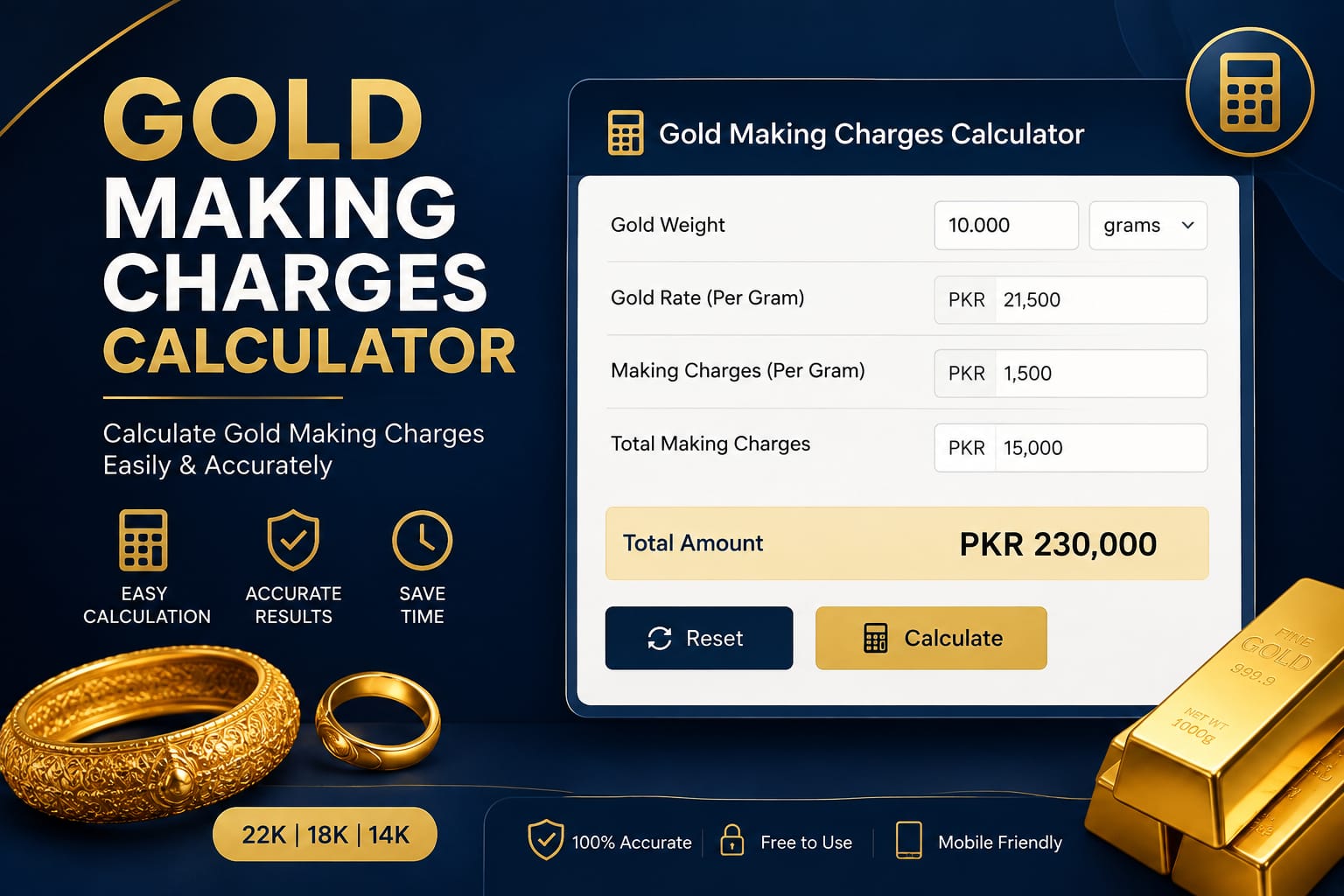
Gold Making Charges Calculator
Pingback: Gold Bullion Calculator Easy 2026